Last updated on July 30, 2026
Amtrak’s Auto Train is a great option for the right move. It is also the wrong option for many moves.
That sounds obvious, but people often compare it to door-to-door auto transport as if both services solve the same problem. They do not. Auto Train is a passenger rail trip with your vehicle riding along between two specific terminals. Door-to-door auto transport is a carrier service built around moving the vehicle from one pickup area to one delivery area while you travel separately.
Transcar helps customers sort this out before they book around the wrong assumption.
Quick answer
The Auto Train usually fits best when:
- You are traveling between the Mid-Atlantic/Northeast and Central Florida.
- Lorton, Virginia and Sanford, Florida are convenient enough.
- You want to ride with the trip instead of flying separately.
- Your vehicle meets Amtrak’s size and check-in rules.
- You can handle terminal arrival, overnight travel, and terminal pickup.
Door-to-door auto transport usually fits best when:
- Your move is not basically Virginia-to-Florida or Florida-to-Virginia.
- You need pickup and delivery near homes, offices, bases, campuses, or storage.
- You are flying, already moved, or cannot travel with the vehicle.
- You have schedule constraints outside a train departure.
- You want the car moved while you focus on the rest of the relocation.
What the Auto Train actually is
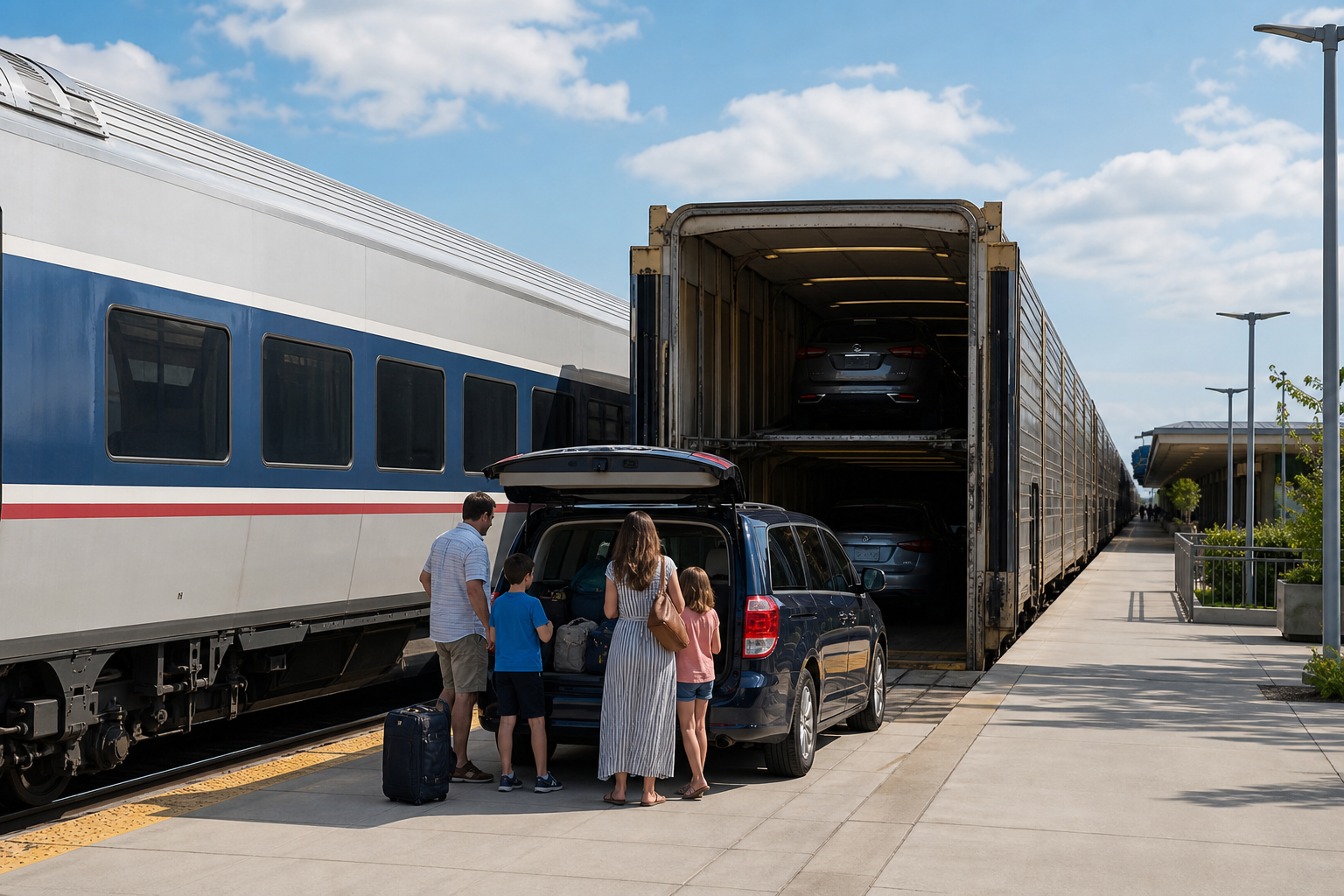
Amtrak describes the Auto Train as a way to bring your automobile, van, SUV, truck, or motorcycle nonstop between Lorton, Virginia and Sanford, Florida. It is designed to save roughly 900 miles of driving along the I-95 corridor while you travel on the train and your vehicle rides in an enclosed auto carrier.
That can be very useful for snowbirds, families visiting Florida, and travelers who were already going between those two regions.
But the route is fixed. The train does not pick up in Boston, Dallas, Chicago, Atlanta, Tampa, or Miami. You still have to get to Lorton or Sanford, and you still have to continue from the destination terminal.
What door-to-door auto transport actually is
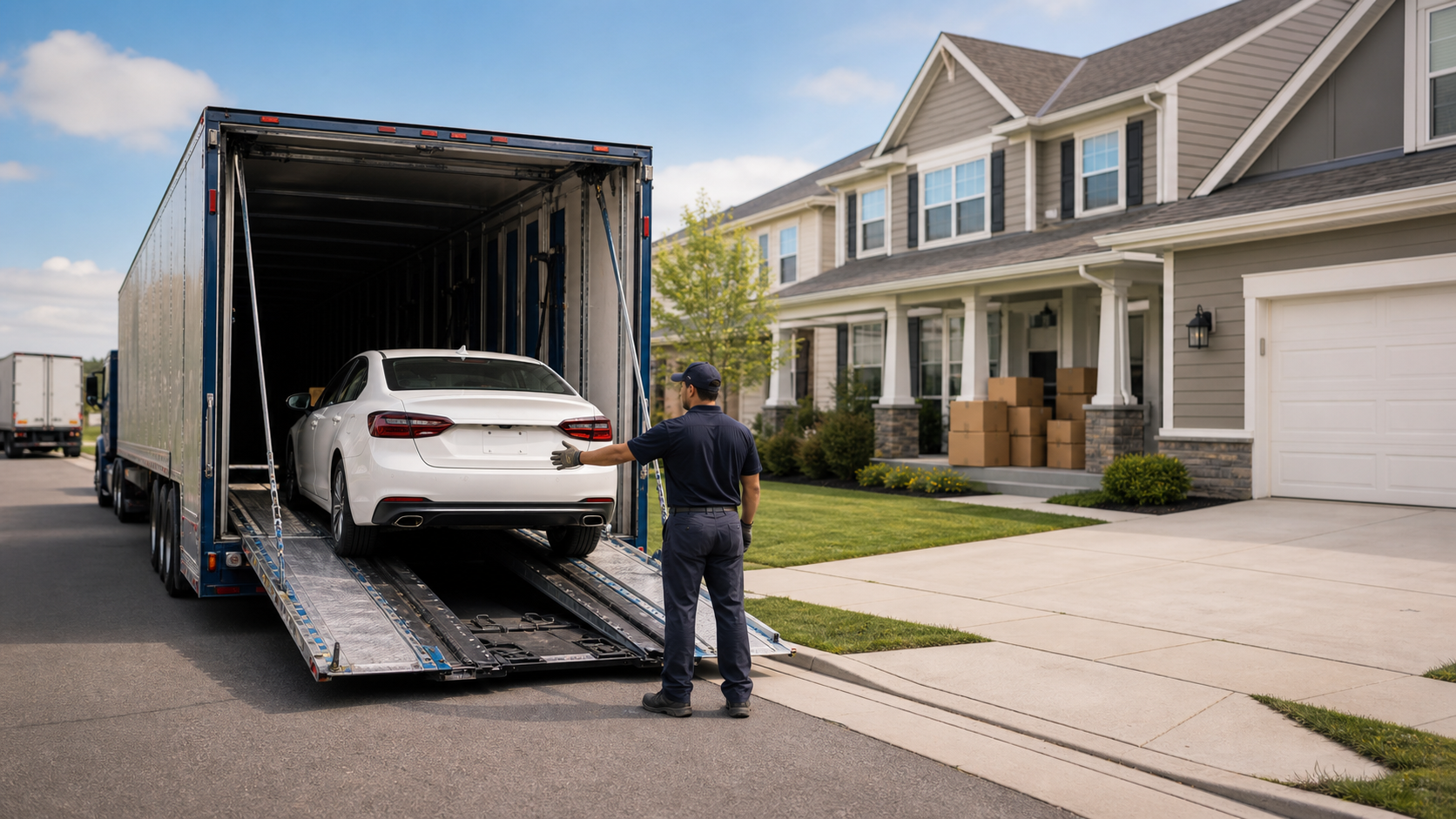
Door-to-door auto transport is not a train ride. It is a vehicle shipment arranged with an auto carrier. The carrier picks up as close as practical to the origin address and delivers as close as practical to the destination address, subject to truck access, local restrictions, and safety.
For a state-to-state move, that flexibility matters. A carrier can help with moves such as:
- Texas to Florida
- Virginia to Arizona
- New York to North Carolina
- California to Tennessee
- Military PCS moves
- College moves
- Dealer purchases
- Estate, auction, or snowbird shipments
You do not need to travel with the vehicle. That is the whole point for many customers.
Route convenience is the first filter
If Lorton and Sanford are both convenient, Auto Train deserves a look. If they are not, add the real miles and time to the comparison.
For example, a customer moving from Philadelphia to Orlando may find the terminals workable. A customer moving from Dallas to Tampa probably will not. Driving hundreds of miles to reach the train, then driving again after arrival, can turn a simple idea into a two-stage road trip.
Door-to-door transport usually wins when the shipment needs to start and end near the actual move addresses.
Time and schedule are different questions
The Auto Train is a scheduled passenger service. You need a reservation, a vehicle reservation, same-day check-in, and overnight travel. Amtrak’s current vehicle guidance says check-in starts at 11:30 a.m.; check-in ends at 2:00 p.m. for oversized vehicles, motorcycles, trailers, and Priority Offloading vehicles, and 2:30 p.m. for standard and extended vehicles. Exceptions cannot be made.
That works if your calendar is built around the train.
Door-to-door transport works differently. Pickup and delivery windows depend on route, carrier availability, equipment, weather, traffic, and dispatch acceptance. It is not instant, but it can be matched to a broader relocation plan. You can fly ahead, meet movers, handle closing dates, or start work while the vehicle is in transit.
Vehicle fit can decide the answer
Amtrak publishes vehicle size guidelines. Standard vehicles are listed with maximum dimensions including 192 inches in length, 85 inches in height, and 84 inches in width including mirrors. Extended vehicles are listed up to 216 inches in length, with the same 85-inch height and 84-inch width guidance. Vehicles over 18 feet require special arrangements. Amtrak also says vehicles wider than 84 inches, including mirrors, cannot be accommodated unless a mirror is removed where applicable.
Auto Train also has prohibited and special-vehicle rules. Dual wheel, gull wing, and scissor door vehicles cannot be accepted, and certain specialty vehicles have limited spaces or additional requirements.
Door-to-door transport has vehicle constraints too, but the equipment options are different. A dispatcher can evaluate open carrier, enclosed carrier, inoperable handling, oversize needs, ground clearance, modified vehicles, and pickup access. The answer may cost more, but the lane is not limited to one train route.
Cost comparison: do not compare only one number
Auto Train pricing usually includes passenger travel plus the vehicle. Depending on the trip, that may be attractive compared with gas, hotel, meals, wear and tear, and a long drive.
Door-to-door transport pricing is usually a shipment quote for the vehicle. You then travel separately by plane, another car, or other transportation.
The fair comparison is not “train ticket vs. shipping quote.” It is total move cost:
- Terminal driving miles
- Fuel
- Meals
- Hotel or overnight accommodations
- Passenger fares
- Vehicle charge
- Rental car needs
- Time off work
- Stress and schedule risk
- Whether you need the car at the exact origin/destination address
Sometimes Auto Train is the better value. Sometimes door-to-door transport is the cleaner logistics answer even if the quote looks higher at first glance.
Which option fits common moves?
Snowbird trip to Central Florida
Auto Train may fit well if Lorton and Sanford are convenient and you want to travel with the vehicle.
Door-to-door transport may fit better if you want the car delivered closer to a Florida home, condo, or seasonal address and plan to fly.
Full household move
Door-to-door transport usually fits better because the car shipment can be coordinated around movers, closing dates, flights, temporary housing, and work schedules.
Auto Train can still work if the route lines up and the traveler wants to personally make that leg.
Military PCS
Door-to-door transport often fits better for non-government vehicle moves, second vehicles, and timing gaps. Auto Train only helps if the move naturally matches Lorton/Sanford and the family can travel that way.
College or job relocation
Door-to-door transport often wins because the pickup and delivery points are usually the school, apartment, home, or family address. Auto Train works only when the geography is unusually convenient.
Transcar takeaway
Amtrak Auto Train is not “bad” and door-to-door transport is not always “better.” They solve different problems.
Choose Auto Train when the fixed Lorton-to-Sanford route, passenger travel, vehicle rules, and terminal timing all match your trip. Choose door-to-door auto transport when the vehicle needs to move between real addresses while you handle the rest of the relocation separately.
If you are unsure, Transcar can help compare the actual pickup, delivery, timing, and cost factors before you commit to the wrong type of move.
Sources checked: Amtrak Auto Train page; Amtrak Auto Train Boarding and Vehicle Requirements; current route and vehicle-dimension guidance reviewed July 29, 2026.

About The Author
Aldo Flores
Aldo Flores is the founder and CEO of Trans Global Auto Logistics (TGAL) and Transcar Auto Shippers. With over 25 years in international vehicle shipping and domestic auto transport, he oversees operations across five logistics companies based in Arlington, Texas.


October 22, 2026

October 15, 2026

October 8, 2026

October 8, 2026

August 13, 2026