
Last updated on July 19, 2026
Dallas car shipping quotes can look simple from the outside: pickup address, delivery address, vehicle, date, price.
The real quote has more moving parts. A carrier is asking a practical question: can this vehicle fit my route, my trailer, my schedule, and my operating cost without creating a delay?
That is why a quote from Dallas to a common metro may price differently than a quote from a tight apartment complex in Plano to a rural delivery point. It is also why a Fort Worth pickup near a major highway may be easier to cover than a same-day pickup request from a downtown garage at 5:00 PM.
Here are the main factors that affect a DFW car shipping quote, and how to keep the number realistic without turning the move into a load-board guessing game.
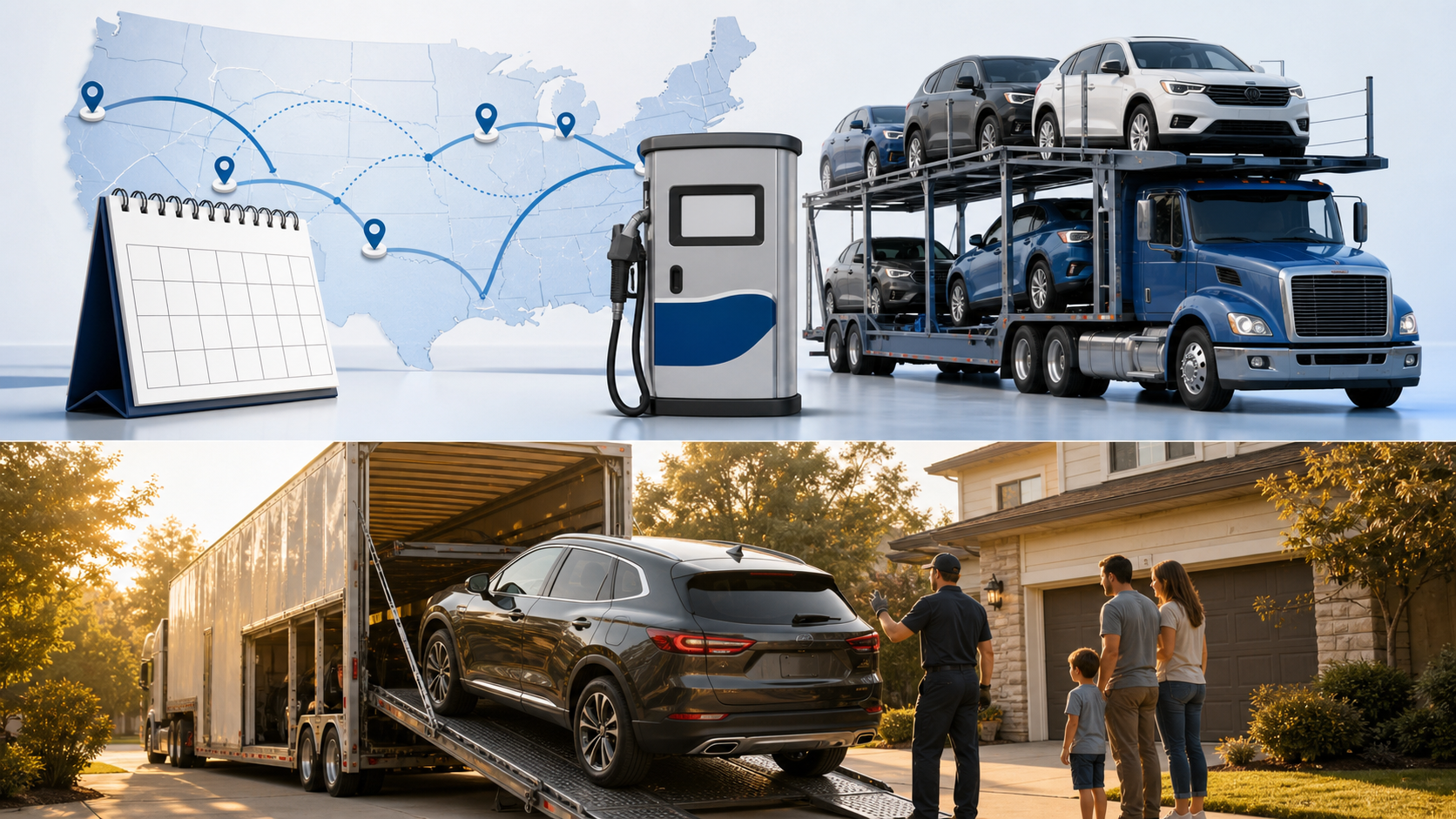
Route density matters more than mileage alone
Mileage matters, but it is not the whole quote.
Carriers price around lanes. A dense lane with regular vehicle movement usually has more truck availability and better pricing. A thinner lane may cost more because the carrier has fewer matching vehicles nearby, fewer return loads, or a less efficient route.
DFW has an advantage because Dallas, Fort Worth, Arlington, Irving, Plano, Frisco, McKinney, and Grapevine sit near major freight corridors. Loads moving through North Texas can connect with I-20, I-30, I-35E, I-35W, I-45, and US-75.
That helps, but it does not make every quote the same. Dallas to Houston, Dallas to Phoenix, or Fort Worth to Southern California may be easier to cover than a small-town pickup or delivery where the truck has to leave the main route for one vehicle.
The best quote is not just “how far is it?” It is “how many carriers are already running close to this lane?”
Pickup and delivery access can change the plan
Most auto transport is door-to-door or as-close-as-legally-and-safely-possible. That last part matters.
A multi-car carrier is long, wide, and not built for every street. Tight neighborhoods, gated communities, apartment garages, low tree branches, narrow cul-de-sacs, steep driveways, and no-parking zones can all create access problems.
In Dallas or Fort Worth, a carrier may be able to get close to the address but still need a safer meetup point. In Plano, Frisco, McKinney, Arlington, Irving, or Grapevine, a wide shopping center lot, dealership, truck stop, business park, or highway-accessible retail center may make pickup faster and cleaner.
That does not always lower the quote directly, but it can improve carrier acceptance. Carriers like stops they can complete without backing a 75-foot rig through a neighborhood that was apparently designed by someone who hates mirrors.
Metro traffic affects pickup windows
DFW traffic is part of the quote because time is part of the quote.
A carrier moving through Dallas during rush hour is not just paying for fuel. They are managing drive time, appointment windows, loading time, and the rest of the vehicles on the trailer.
Downtown Dallas, Fort Worth, the I-635 loop, I-35E, I-35W, I-30, and airport-area traffic near DFW International can all affect timing. A pickup in Grapevine or Irving may be simple at one time of day and painful at another.
This is why exact pickup times are hard to promise before a carrier is assigned. A realistic dispatcher will give a pickup window, then tighten the timing once the truck’s route is confirmed.
Open vs enclosed transport changes the carrier pool
Open carrier is usually the best starting point for standard Dallas car shipping.
Open trailers carry most daily drivers, SUVs, pickups, and used-car purchases. There are more open carriers on the road, so pricing is usually better and availability is usually stronger.
Enclosed transport makes sense for vehicles that need more protection:
- Classic cars
- Exotic or high-value vehicles
- Fresh restorations
- Low-clearance vehicles
- Collector vehicles
- Cars where weather exposure is a real concern
Enclosed shipping costs more because there are fewer enclosed carriers, fewer spots, and more specialized loading requirements. If you are shipping a regular family car from Arlington to another major metro, open carrier is usually the practical option. If you are moving a restored classic out of McKinney, enclosed may be worth the extra cost.
Seasonality can tighten carrier availability
Auto transport has seasonal swings.
Summer is busy because families move, students relocate, military PCS moves pick up, and people buy vehicles from out of state. Snowbird season can tighten certain lanes. Holidays can reduce available driving days. Bad weather can slow carrier schedules even when DFW itself is clear.
When demand rises, carriers have more loads to choose from. That can push prices up, especially if the pickup window is tight.
If your dates are flexible, say so early. A few extra days can make the difference between chasing a truck and matching your vehicle to a carrier already moving through North Texas.
Vehicle size and running condition affect loading
A compact sedan and a lifted pickup do not take up the same space on a trailer.
Carriers price around space, weight, and loading difficulty. Larger SUVs, long-bed trucks, dually pickups, oversized tires, roof racks, and modified vehicles may cost more because they take more room or require different placement.
Running condition matters too. If the vehicle starts, steers, rolls, and brakes, it is easier to load. If it does not run, the carrier may need a winch and more time. Not every carrier will accept inoperable vehicles, so the available carrier pool shrinks.
Be direct about the vehicle condition. A quote based on “runs and drives” can fall apart quickly if the driver arrives and the car will not start.
Timing flexibility can protect the quote
A hard pickup date usually costs more than a flexible pickup window.
If the vehicle must be picked up on one exact day, the dispatcher has fewer carrier options. If the vehicle is available over several days, the dispatcher can match it to a truck already running the lane.
Transcar’s 7-Day Pickup Guarantee is built around realistic dispatching. The goal is not to email the lowest possible number and hope someone takes it. The goal is to quote the move so the vehicle can be picked up within seven days.
That is the difference between a quote that looks good and a quote that actually moves.
Airport and suburb access can help or hurt
DFW International Airport and Dallas Love Field make North Texas a common travel hub, but airport-area pickups are not always ideal for large carriers.
Airport roads, hotel loops, rental car areas, security rules, traffic, and limited loading space can complicate pickup. If you are flying in or out, it may be easier to meet the carrier at a nearby hotel, shopping center, business park, dealership, or storage lot with room to load safely.
The same idea applies across the suburbs. A pickup in Frisco, Plano, McKinney, Grapevine, Irving, or Arlington may be simple if the address has room. If not, a nearby meetup point can save time and reduce dispatch friction.
Carrier availability is the final price test
A car shipping quote is only useful if an insured carrier will accept it.
That is where fake low quotes cause problems. A broker can email a low number, but the vehicle still has to be assigned to a real carrier with the right route, insurance, equipment, and schedule.
If the price is too low for the lane, the car sits. Then the customer gets a call asking for more money after the clock is already tight.
Before booking, ask practical questions:
- Is this price realistic for the lane right now?
- What pickup window is built into the quote?
- Is this open or enclosed transport?
- Does the quote assume the vehicle runs and drives?
- Are there access issues at pickup or delivery?
- When is payment due, and what happens before dispatch?
- Can I verify the carrier once assigned?
You can also use FMCSA resources to look up motor carrier or broker operating authority, insurance, and related records. That is not exciting reading, but neither is explaining to your spouse why the “too good to be true” quote is now entering its villain arc.
How to get a better Dallas car shipping quote
The best way to improve a DFW auto transport quote is to make the move easier to dispatch.
Before requesting a quote, have this ready:
- Exact pickup and delivery ZIP codes
- Vehicle year, make, and model
- Whether the vehicle runs, steers, rolls, and brakes
- Open or enclosed transport preference
- Earliest pickup date
- How flexible your pickup window is
- Any access notes for apartments, gated communities, airports, storage lots, or dealerships
- Whether you can meet near a major road if the truck cannot safely reach the address
If you are in Dallas, Fort Worth, Arlington, Plano, Irving, Frisco, McKinney, Grapevine, or anywhere else in the DFW area, the right quote should reflect the lane, the vehicle, the timing, and the real carrier market.
Not the cheapest number on a screen. The number that gets the car picked up.

About The Author
Aldo Flores
Aldo Flores is the founder and CEO of Trans Global Auto Logistics (TGAL) and Transcar Auto Shippers. With over 25 years in international vehicle shipping and domestic auto transport, he oversees operations across five logistics companies based in Arlington, Texas.


October 22, 2026

October 15, 2026

October 8, 2026

October 8, 2026

August 13, 2026