
Last updated on July 19, 2026
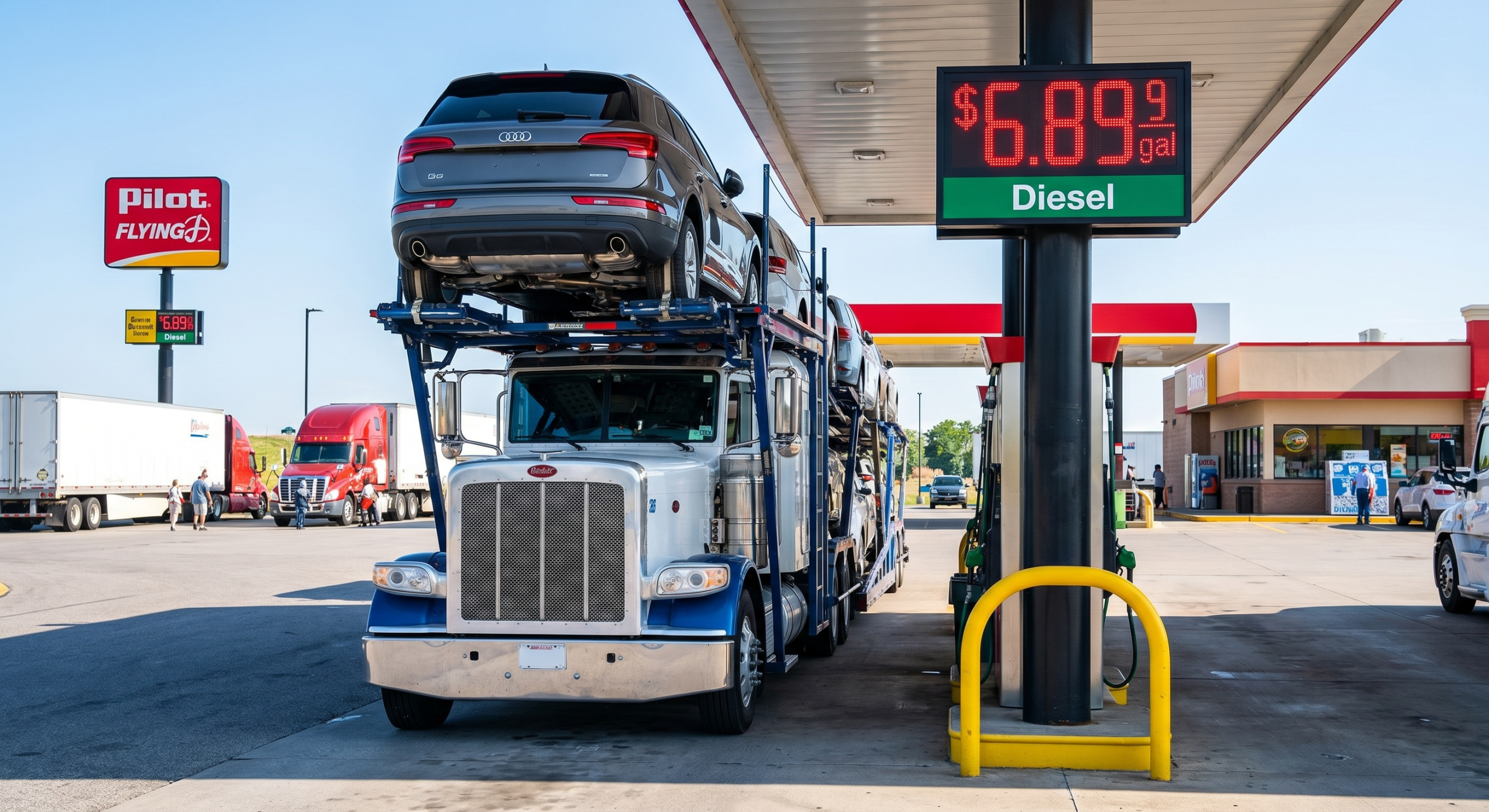
Diesel prices dropped this week. So why did your car shipping quote not drop the same afternoon?
Fair question. Diesel is a real cost in auto transport, but it is not the only cost. More importantly, car shipping rates do not move like gas station signs. A fuel headline can change today while the carrier market takes days, or sometimes weeks, to work that change into actual accepted loads.
Here is what is happening behind the quote.
Diesel matters, but carriers do not reprice every load instantly
Every open car carrier on the road runs on diesel. When diesel rises, carriers feel it quickly. When diesel falls, the relief is real, but it does not always show up in same-day transport pricing.
One reason is timing. The U.S. Energy Information Administration publishes weekly on-highway diesel price estimates based on Monday prices. Many transportation fuel surcharge models and market updates use weekly benchmarks, not hourly pump prices.
That means a lower price you see in the news may not be reflected in the carrier’s current rate sheet, dispatch plan, or load board decisions yet.
Carrier rate cycles lag fuel headlines
Carriers usually look at pricing in cycles: this week’s lanes, this week’s booked loads, this week’s available trucks, and this week’s driver schedule.
If a carrier already priced Dallas to Phoenix at a certain number on Monday, they are not likely to rework every posted or negotiated load on Thursday just because diesel moved down a few cents. They still have payroll, insurance, maintenance, truck payments, trailer costs, permits, tolls, and deadhead miles to cover.
Fuel is a big piece. It is not the whole truck.
Lane availability matters more than the national diesel average
A national diesel average does not tell you whether there are enough carriers on your exact route.
A quote depends on the lane:
- Is your pickup city on a common carrier route?
- Is your delivery city easy to reach with a full trailer?
- Are carriers already moving through that market?
- Will the driver need to deadhead empty after delivery?
- Is the vehicle oversized, modified, inoperable, or requiring enclosed transport?
If diesel drops but the lane is tight, the quote may not move. A carrier with only one open spot on a trailer is going to accept the load that best fits the route and pays enough to make the trip worth taking.
That is not Wall Street. That is a driver with nine vehicles, a logbook, and a route that has to make sense.
Booked loads are already locked in
Many transports are arranged days before pickup. Once a carrier accepts a load at an agreed rate, that rate does not usually get rewritten because diesel moved after the dispatch was set.
This cuts both ways.
If diesel spikes after your rate is locked, a good broker does not call you and add money just because fuel got worse. If diesel drops the next day, the carrier does not usually reopen the deal and give money back either.
At Transcar, we care more about quoting a move that can actually be picked up than chasing a number that only looks good on paper.
Dispatch lead time creates a natural delay
Car shipping is not instant. A dispatcher has to match your vehicle with a carrier that has the right equipment, route, timing, and space on the trailer.
That takes lead time. A quote built for a pickup window this week reflects the trucks that are available this week. If fuel prices keep dropping and carriers start accepting lower all-in rates next week, quotes may adjust then. But there is usually a delay between the market headline and the carrier’s accepted price.
This is also why booking too late can cost more. Last-minute moves often require the dispatcher to compete harder for carrier attention, especially if the lane is already busy.
Insurance, equipment, and labor costs do not fall with diesel
Fuel can move down quickly. The rest of the carrier’s cost structure usually does not.
Auto carriers still pay for:
- Commercial cargo and liability insurance
- Driver wages and retention
- Truck and trailer payments
- Maintenance, tires, repairs, and parts
- Permits, compliance, tolls, and load board fees
- Time spent loading, unloading, and inspecting vehicles
Those costs have been sticky. A small fuel drop helps, but it does not erase the full cost of operating a car hauler.
Seasonal demand can overpower a fuel drop
Summer is peak moving season. Military PCS moves, family relocations, college moves, dealer activity, snowbird repositioning, and vacation schedules can all tighten carrier capacity.
When demand is high, a diesel drop may slow the increase in rates instead of creating an immediate decrease.
That is frustrating, but it is better to understand it before you plan around a price drop that may never reach your specific route.
Broker pricing has to account for whether the load will actually move
A broker can quote almost any number. The hard part is getting a qualified carrier to accept the load at that number.
This is where customers get burned. A broker may quote low because diesel fell, then fail to get a carrier at that rate. A day before pickup, the customer gets the call: “The carrier needs more money.”
That is not a quote. That is bait with a dispatch problem attached.
An honest quote moves slower because it has to survive the real market. It should account for fuel, the lane, timing, equipment, vehicle size, carrier availability, and whether a vetted carrier is likely to accept the load without a last-minute price change.
Where Transcar’s 7-Day Pickup Guarantee fits in
Transcar’s 7-Day Pickup Guarantee is built around practical dispatch, not fantasy pricing. We quote with the goal of getting your vehicle picked up within the guaranteed window by a qualified carrier.
Could we post a lower number and hope? Sure. That is how freight turns into a circus with straps.
We would rather give you a rate that reflects the lane and timing, then work the dispatch properly. If fuel keeps easing and the carrier market follows, quotes can come down. But we are not going to pretend the market changed before carriers are actually accepting lower rates.
How to read a quote when diesel is falling
If you are comparing quotes, ask these questions:
- Is this a firm quote or only an estimate?
- Is the carrier rate already realistic for my lane?
- Does the quote include fuel, insurance, broker fee, and door-to-door transport?
- What happens if no carrier accepts the posted rate?
- Is there a pickup window or guarantee in writing?
The lowest quote is not always the cheapest move. If the price changes after you book, the “cheap” quote was just paperwork with a trapdoor.
Bottom line
Diesel price drops help the auto transport market, but they do not reset quotes the same day. Carrier rate cycles, booked loads, lane availability, dispatch timing, operating costs, and seasonal demand all create a lag.
The honest answer is simple: quotes come down when carriers on your actual route start accepting lower rates consistently.
Until then, the best quote is the one that is clear, realistic, and actually gets your vehicle picked up.
Need a current rate for your route? Get an instant quote from Transcar and ask about the 7-Day Pickup Guarantee.

About The Author
Aldo Flores
Aldo Flores is the founder and CEO of Trans Global Auto Logistics (TGAL) and Transcar Auto Shippers. With over 25 years in international vehicle shipping and domestic auto transport, he oversees operations across five logistics companies based in Arlington, Texas.


October 22, 2026

October 15, 2026

October 8, 2026

October 8, 2026

August 13, 2026